
Cleaning Got You Down?
Join the Revolution--the Self-Cleaning House!

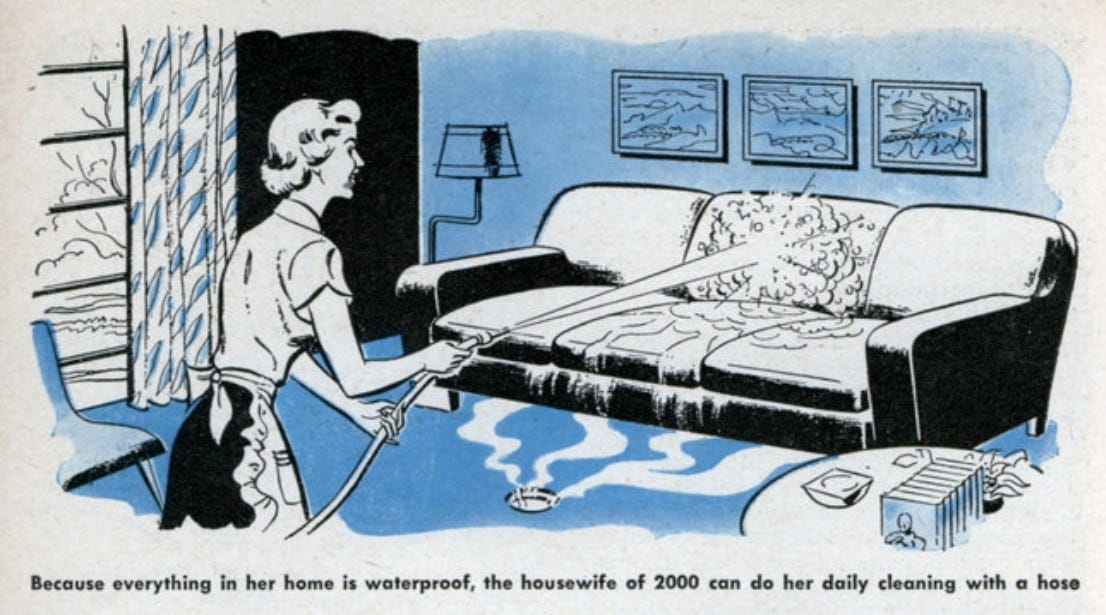
In the Renaissance, people believed that inspiration came from angels who whispered into your ears. It made ideas seem blessed and blissful. Angels whispered into Francis Gabe’s ears. The idea the angels implanted launched Gabe on a quixotic quest to realize her dream.
Gabe’s goal was to liberate women from the drudgery of housework, to free women from the yoke of housecleaning they had been saddled with by men. Gabe once said:
The problem with houses is that they are designed by men. They put in far too much space and then you have to take care of it.
Gabe was born Frances Grace Arnholz in 1915, on a farm near Boise, Idaho. Her father was an architect and builder, who moved his family 16 times.
Frances Gabe met her husband when she was 13. They waited for her to finish Girls Polytechnic High School in Portland, Oregon. Within a year at age 17, she married Herbert Grant Bateson, and became Frances Arnholz Bateson. After 35 years, they divorced. Gabe decided to change her name. She took the first letters of her middle name, maiden name, and married name to form GAB. She added an “e” lest anyone think she was a chatty Cathy. While they were married, they ran a construction and repairs business; Gabe was the boss, but she seemed to think of him as a pest. Gabe told a reporter in an interview:
From the time I was 13, there was no getting rid of him.
So one day, she banished him to a trailer home in their backyard. Suddenly, the separation she had long thought about was real. She was sobbing:
I was sitting here alone, crying as hard as I could cry. Then, I prayed. I said, “Father, give me something to do so big, so all-consuming, so useful, that it would use all of me.” So I could keep going.
As she dried her tears, she picked up a pencil and began absentmindedly doodling, trying to collect her thoughts. Suddenly, she felt a pair of angels— like a triptych from the Renaissance—on her shoulders.
She looked down at her scribbles and she knew. She was inadvertently drawing her life’s work: the self-cleaning house.
Have you ever had a moment when you take a break from your cleaning chores and wonder if it’s worth it? Wouldn’t it be great to just flip a button and be done? As Gabe said:
Housework is a thankless, unending job. It’s a nerve-twangling bore. Who wants it? Nobody!
And so, she launched into a lifelong quest to solve the house cleaning dilemma. She started by installing a glass shower stall outside to study the flow of water. She had two guiding principles: sluicing water and avoiding any stooping:
Stoop! Stoop! Stoop! Stupid!
Eliminating stooping should relieve her back pain, she reasoned. Gabe also remembered an infuriating dribble of fig jam on a wall from her married days:
I thought, darn it, this is more than I can handle. So, I brought out the hose.
Memories of fig jam led her to adapt water sluicing throughout the house.
She began her design in 1940 and construction in 1970. She built a 30 x 45-foot cinder block house. Each room had overhead pipes with rotating water spray fittings—like an upside-down lawn sprinkler. Soap was mixed into the water through a contraption. The first spray was sudsy water everywhere, the second spray rinsed, followed by jets of drying, warm air.
The floors had a nearly imperceptible slope of ½ inch per 10 feet leading to gutters along the walls. The gutters routed the water through the fireplace and into the doghouse, cleaning both dogs and doghouse. Gabe kept great Danes.
Everything in the house was waterproof: pictures and books were covered in plastic. Furniture was lifted off the floor on castors and was upholstered with waterproofing. The wood floors were coated with multiple layers of marine varnish. When cleaning time arrived—twice a year—Gabe would don foul weather gear and an umbrella and touch the starter button. Each room took about an hour.
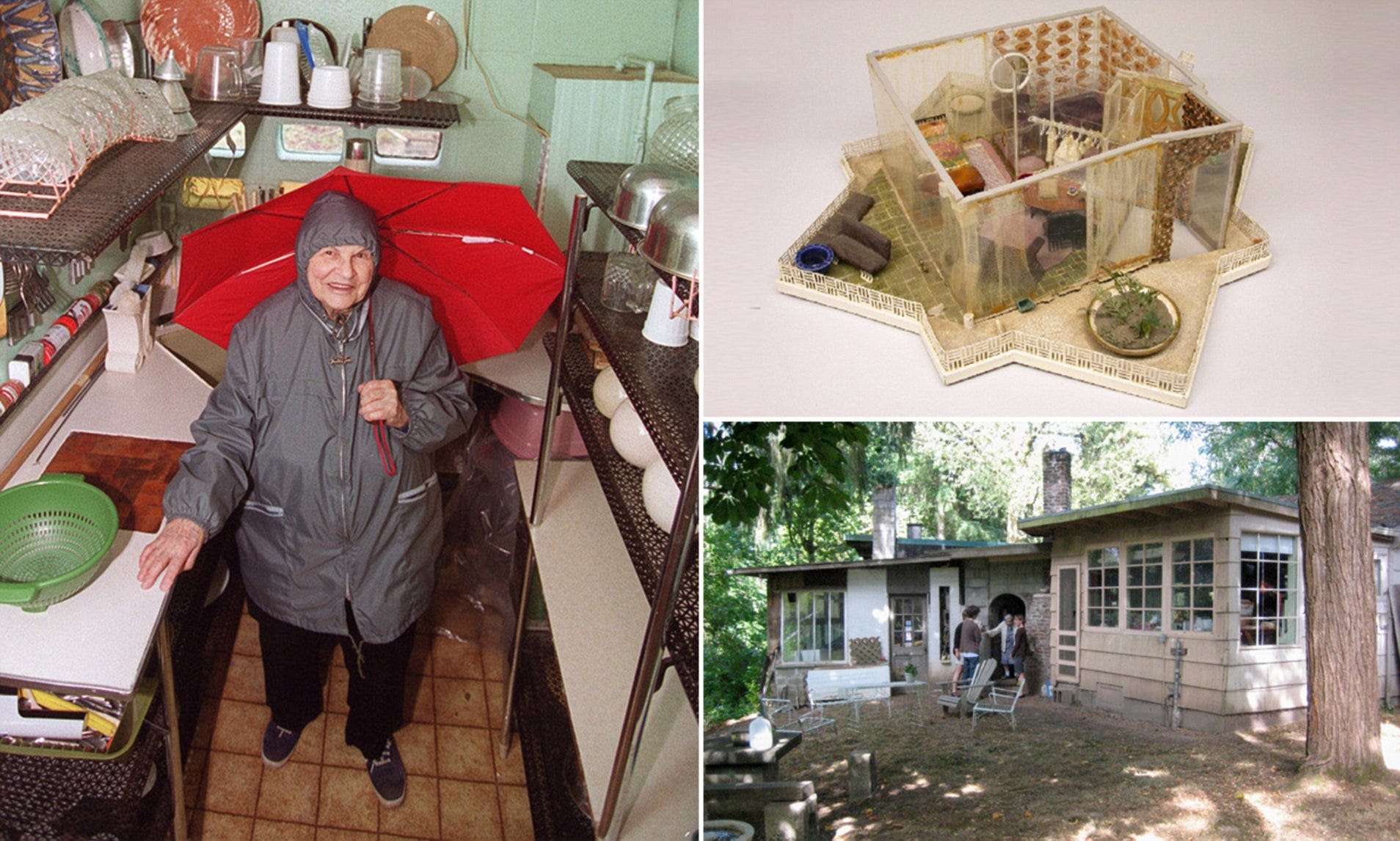
She encountered numerous unexpected problems, but diligently invented solutions. For example, she built a self-contained dishwasher, dryer, and cupboard—eliminating the need for stacking and re-stacking dishware. Clothes were tucked into a sealed cabinet, washed, dried, and automatically slid down a pole into the closet.
In total, she patented 68 ideas from inside her house like the self-cleaning bathtub and washbasin. and, of course, the house itself. She dreamed of self-cleaning houses all over the country. So, she welcomed press interviews, tourists, and TV talk-show appearances. One visitor said that the house had a slight smell of mildew.
However, Gabe seemed to be motivated as much by annoyance as altruism:
Housework stuck in my craw even when I was a kid. You can talk all you like about women’s liberation, but houses are still designed so women have to spend half their time on their knees or hanging their head in a hole.
I didn’t like my husband anymore, so I kicked him out to the backyard.
Her cantankerous streak revealed itself when she was young:
I had a heck of a time in school. Everything moved much too slowly. My last day, I stood up in class and screamed at my teacher, ‘You told us that last week!’
Her own lawyer, Allyn Brown, told the New York Times that:
She was very difficult to get along with. She had an adversarial relationship with all her neighbors, and she didn’t do anything to discourage it.
According to Brown, she often paid him with Pepsi-Cola.
She kept a cement mixer in her yard and did her yard work in the nude. One of her neighbors told People magazine that she was a “dumb bat.” She referred to her neighbors as “the stinkers.”
If you turned into the dirt road down to her house, you might have turned around. She posted a sign that read “Don’t feed the bull or trample on the poison oak.”
Gabe was a visionary and a curmudgeon. The idea of self-cleaning house may have crossed many people’s minds but was quickly dropped as a fantasy. However, Gabe brought determination and persistence to her idea. Even after she ran out of money and was unable to renew her patents.
Her ideas seem to emerge more from spite than from “the better angels” on her shoulders. She hated housework and considered men an anathema. Perhaps, it never occurred to her that men can do housework just as easily as women.
Francis Gabe lived the last 8 years of her life in a nursing home. She died at 101 in 2016.
She never surrendered her dream:
Some people have no vision or imagination. My dream is to have self-cleaning houses the world over. Ten years ago they told me I was 20 years ahead of my time, but I think people are ready for what I’ve got right now.
*****
Dan Hunter’s book, Learning and Teaching Creativity, is available from
https://itascabooks.com/products/learning-and-teaching-creativity-you-can-only-imagine
Teachers receive a 20% discount.
Audiobook is available at
https://www.audible.com/pd/Learning-and-Teaching-Creativity-Audiobook/B0CK4BQDJP
We need more Francis Gabes and self-cleaning houses.