
Hand Turkeys
The True Meaning of Thanksgiving

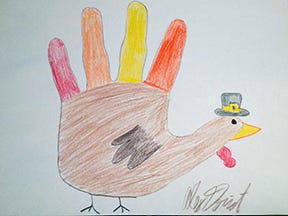
Thanks to Charlie Brown TV specials, we know that holidays are supposed to have some kind of “true meaning.” Thanksgiving is the fat bird of holidays all stuffed with history, art, tradition, and celebration. But if it has a meaning—you can find it in hand turkeys made from a single handprint. That’s the true meaning of Thanksgiving.
The tradition of tracing a child’s handprint is older than Charlie Brown, even older than the pilgrims. The handprint art found in prehistoric caves is estimated to be 40,000 to 45,000 years old. The oldest may be 64,000 years old. No one knows how many cave handprints exist in caves scattered around the world.
Thankfully, humanity can trace the handprint art of the Paleolithic era through thousands of years directly to the traditional Thanksgiving art of drawing hand turkeys.
Hand turkeys are the rare art form suitable for mastery by children and adults. For the 2-D version, spread your hand (or anyone’s hand) on a piece of paper. Now, trace around the fingers. Remove the hand and there’s your turkey. The thumb is the head. The other fingers are feathers. Color to taste.
Not to brag, but over the years I’ve made a lot of hand turkeys, easily 3 or 4. So, I am something of an expert. In fact, I made a 3- D hand turkey from my handprint in wet clay, then kiln-fired, and glazed. It takes a dedicated soul to glaze a clay hand turkey.
I made hand turkeys in Sunday School at Plymouth Congregational Church in Des Moines, Iowa.
On Thanksgiving Day, we were relieved of hand turkey duty to explore our mystical ties to the first Thanksgiving of the 1620 Pilgrims and to find the “true meaning” of Thanksgiving.
The church shared a nom de église with the Plymouth, Massachusetts pilgrims. But even more than name, we were the modern-day pilgrims, brothers and sisters of the originals. And we kept faith with our ancestors with hand turkeys and roast turkey.
So, to demonstrate our fealty to faith, fear, and football, the church reenacted a pilgrim worship service each Thanksgiving. We were summoned to the Thanksgiving church service by a drummer boy in pilgrim attire. By his side, a deacon garbed as a pilgrim stood guard with a blunderbuss in case of an Indian attack.
Inside the church, deacons and their luckless families were dressed as sober pilgrims. They silently ushered the congregants into the sanctuary, seating the men on one side and women on the other in the interest of historical and spiritual authenticity.
The choir members and ministers also wore all black with starched white falling band collars laced at the neck with black ribbon. They wore oversized brass rectangles—larger than a double electric outlet frame— on their shoes, belts, and black cone hats. We were to imagine that we were in the 17th century watching real Pilgrims.
Except, they were dressed as Puritans. The Puritans arrived in New England long after the Pilgrims. They were church reformers who wanted to purify the Church of England. The Pilgrims were “separatists” who were persecuted. The Puritans were wealthy enough to wear all black. Black dye and brass buckles were expensive, a way for the Puritans to show off. However, the Pilgrims were too poor to wear all black, dressing in bright reds, greens, and blues. The Pilgrims wore flat, farmer hats not the black cone hats of the Puritans. So, naturally, the 1966 Deacons all wore black cone hats with brass buckles. And when you looked at the Deacons, you knew them. They were fully domesticated dentists, tax lawyers, bankers, and insurance men.
The first Thanksgiving in 1621 was a celebration of the successful Plymouth Colony harvest. Although four Pilgrims hunted “fowl” for the dinner, no one knows if there was turkey. However, a letter written to attract new colonists claimed that the three-day harvest celebration included lobster, fish, eels, mussels and oysters plucked from the rocks on the shoreline.
For the next 200 years, private harvest feasts of thanksgiving were held sporadically in New England. In 1837, Sarah Josephra Hale, editor of Godey’s Lady’s Book, began campaigning to make Thanksgiving a national holiday. Finally in 1863, Abraham Lincoln issued the first Thanksgiving proclamation. Lincoln’s goal was to have a purely American holiday to inspire the Union during the Civil War.
Oddly, the Pilgrims were not associated with the new holiday, not even mentioned until 1865. In 1872, Hale finally acknowledged the Pilgrims in her hymn, singing “free to do and pray/and keep in sober gladness/ Their first Thanksgiving Day.” There was no mention of Pilgrim feasting. (Certainly, “sober gladness” is the word of the day in modern Thanksgivings.)
After the Civil War, artists and writers began to romanticize the Pilgrims. They painted the Pilgrims as serious, black-robed Puritans gorging on everything in sight. In 1889. Jane G. Austin wrote that the Pilgrims dined on “turkey stuffed with beechnuts, other types of fowl, venison, boiled beef and other roasts, oysters, clam chowder, plum-porridge, hasty pudding, sea biscuit, manchet bread, butter, treacle, mustard, turnips, salad, grapes, plums, popcorn, ale, and root beer.” (Perhaps a list of foods desired by Ms. Austin.)
The pseudo black Pilgrim clothing and feasting were all fabricated to propagate an American myth of prosperity and good will.
The 19th century writers also concocted the myth of the Wampanoag indigenous people befriending the “peace-loving” Pilgrims. In their first months, the Pilgrims raided Wampanoag summer villages, stole seed corn, and had a shootout with Wampanoag warriors. The Wampanoag faced threats from other tribes. So, Massasoit Sachem (or chief) negotiated a mutual defense pact with the Pilgrims. Tisquantum, or Squanto, a Wampanoag who had been enslaved by the English, did indeed teach farming and fishing to the Pilgrims.
However, the Wampanoags were not invited to the 1621 Thanksgiving. Massasoit heard the Pilgrims firing their blunderbusses. Assuming an attack, he brought 90 armed warriors to help defend the village. It was a false alarm. In a flash of future Iowa-style hospitality, the Pilgrims offered an ambivalent “well, since you’re already here” invitation to share in the dinner.
In addition to dressing Pilgrims as Puritans, Plymouth Church tried to represent the Wampanoags by recruiting two white boy scouts from the nearby scout camp, Camp Mitigwa. Feathers in their hair, the boy scouts pranced around in buckskin loincloths, looking like Hollywood Indians scooped from the Daniel Boone TV show.
After sampling TV westerns, the service swapped 17th century history for 20th century expressive dancing. Barefoot, high-school girls leaped, swooned, and twirled in sheer rayon gowns—pale blue—with white gossamer trains fluttering behind. Known as the Rhythmic Dancers, their eyes glistened with soulful devotion as they gracefully offered their hands up to the lights in the ceiling.
What’s religion without suffering? Or at least, a metaphor for us to understand the Pilgrim ordeals. The deacons handed out cellophane envelopes stapled to yellow cards to represent the food rations per Pilgrim during the winter of 1620-21. Each card had five rock-hard corn kernels of field corn and an explanation of hunger and suffering. I tried to eat one. I never did that again.
Thanksgiving in Des Moines 1966. Pilgrims in Puritan costumes. Fake Indian dancers. Five kernels of field corn. Silent rhythmic dancers. Each step in the service designed to cement our self-perceptions that we were like the Pilgrims:
We were devout and somber like the Pilgrims. We were neighborly, extending the hand of friendship to the Indigenous people. We learned compassion for the starving and poor. We were bewildered by the silent epiphanies of the rhythmic dancers.
Stuffed with knowledge, we carefully carried our paper hand turkeys home to present to Mom and Dad. The name of the child artist was written on the hand turkey in big block print, essentially saying, “look what I did, this is me, my handprint made this turkey.”
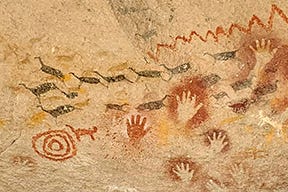
Scientists conjure lofty explanations for prehistoric handprints on cave walls: the hand is a sacred symbol of the human soul. Or a means of connecting with the spirit world.
I believe that prehistoric people made handprints for the same reason we make all art—to say that we are here, a statement of our individual existence, “this is me.”
So, at Thanksgiving 1966, we also put our handprints on the cave walls of history: we made hand turkeys.
****
Dan Hunter’s book, Learning and Teaching Creativity, is available from
https://itascabooks.com/products/learning-and-teaching-creativity-you-can-only-imagine
Teachers receive a 20% discount.
Audiobook is available at
https://www.audible.com/pd/Learning-and-Teaching-Creativity-Audiobook/B0CK4BQDJP
gotta say it man: You are the straightest "cat" on Substack -if you do not mind me using slang words please. You are my break time when I have been screwed around enough by all the sharpies on this damn platform!!!!# keep it up, I guess...
Nothing rattles you, dude. You the ultimate "straight act."
It is obvious that, for you, that the hand turkey is an icon of great nostalgia. And there are other perspectives that can illuminate a deeper engagement of the political and anti-cultural context of that icon. I ask that your readers look into the decades-long presence and work behind the National Day of Mourning held each year in Plymouth, organized by the United American Indians of New England. I also suggest people look into the work of Stephen Newcomb, particularly his book, "Pagans in the Promised Land" and documentary, "Doctrine of Discovery: Unmasking the Domination Code".