
One Lump or 35?
Louisa May Alcott would make a good chemist


In 1834, Fowler M. Ray worked as a blacksmith assistant. One day Ray recognized a man walking by. The shop door was open to mitigate the heat. Ray was soaked in sweat, covered in dust. But Ray called out to the stranger. It was Lorenzo Fowler, an itinerant Phrenologist. Fowler was in town for a few days to lecture and conduct readings for a fee. Ray continued:
Please to put your hand on my head, and tell me if I must work all my life here.
*******
Phrenology was a new pseudo-science that was becoming very popular in the first half of the 19th century. Lorenzo Fowler and his brother Orson were the leading American practitioners and missionaries for the new “science.” They argued that skilled examination of the size and shape of the bumps and lumps on the head provided insight into an individual’s character and abilities. Their only tools were a tape and calipers to measure the head and their fingers to probe the surface of the skull.
Initially, there were 35 areas of the skull to be rated for size: from two for small up to seven for very large. Each of the 35 skull locations—later 37 and eventually 40—corresponded with a personality trait such as “Conjugality,” “Combativeness,” “Secretiveness” and “Amativeness” among others. (In Phrenology, amativeness was propensity to love and to experience sexual feelings.)
The theory of Phrenology posited that each of these traits were controlled by specific areas, or “organs” of the brain. The more developed the trait, the larger the organ and, hence, the larger protrusion—bump— in the skull.
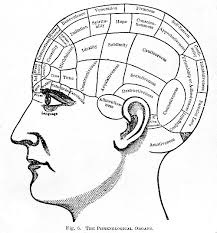
Phrenology came from the teaching of Franz Joseph Gall, an 18th century Viennese doctor, who observed that the schoolmates who were adept at memorizing long passages all had prominent eyes and large foreheads. From those two external features, Gall went on to add more. Gall was run out of Vienna by the Catholic church for placing physical biology above the spiritual. So, he launched a lecture tour of Europe joined by a younger colleague, Johann Kaspar Spurzheim.
Spurzheim coined the term “phrenology” by joining the Greek words for mind and knowledge. Armed with an official sounding scientific “ology,” Spurzheim traveled to America in 1832 to spread the new neural “gospel.”
Orson Fowler, a young ministry student, fell under Spurzheim’s influence. Orson and his younger brother, Lorenzo, became eager converts. They took up the mantle of lecturing on Phrenology and conducting skull readings. The lectures were free; however, it cost 2 cents a head for a reading.
The Fowlers adopted the slogan “Know Thyself.” Phrenology not only opened up new paths for self-understanding, but it also promised a means for self-improvement. The Fowlers taught that you could develop and even perfect your shortcomings by building up that specific “organ” of the brain.
Soon, the Fowlers decided that phrenology was more than a tool to seek individual perfection. It could also power the social reform moments of the day. The education reformer Horace Mann described phrenology as the greatest discovery of the age. Phrenology would improve schools and lead prison reform. The Fowlers began to speak out in favor of temperance, vegetarianism and sex education.
The Fowlers set up a studio in New York City to examine the heads of common people and famous people alike, though the fee had risen from 2 cents to a dollar. The Fowlers palpated the likes of Horace Mann, Julia Ward Howe, Clara Barton, John Greenleaf Whittier, sculptor Hiram Powers, the actor Edwin Forrest and poet Walt Whitman.
In 1849, Walt Whitman asked for a head reading. Lorenzo Fowler recorded Whitman as strong in “animal will” with “fondness for women and children,” “a perfect sense of oneness with nature” and “Alimentiveness, passion for food and drink.” Whitman saved Lorenzo Fowler’s “Phrenological Notes on W. Whitman” for the rest of his life. He quoted it often and used it as the inspiration for Whitman’s concept of the cosmically-chosen poet prophet. (Whitman was the poet-prophet.)
On November 22, 1873, Louisa May Alcott sat for a head reading. Fowler wrote of Alcott’s head:
Faith, hope and charity very large
With large Language Continuity, Constructiveness, and Ideality, should write and speak with great fluency, correctness, and elegance, and in a style distinguished for clearness as well as for beauty; but with these organs moderate or small, there will be a liability to broken metaphors and imperfect and confusing comparisons.
You would make a good chemist.
Mark Twain remembered itinerant phrenologists coming to Hannibal, Missouri when he was a boy in the 1840s:
It is not at all likely, I think, that the travelling expert ever got any villager’s character quite right, but it is a safe guess that he was always wise enough to furnish his clients character charts that would compare favorably with George Washington’s. … I still remember that no phrenologist ever came across a skull in our town that fell much short of the Washington standard.
In 1872 or 1873, Twain, under a pseudonym, had his own head reading with Lorenzo Fowler. Initially it pleased him:
I came out safe and sound, at the end, with a hundred great and shining qualities; but which lost their value and amounted to nothing because each of the hundred was coupled up with an opposing defect which took the effectiveness all out of it.
According to Twain, Fowler noted a cavity in his skull where a bump should have been. Twin wrote:
[Fowler] startled me by saying that that cavity represented the total absence of the sense of humor!
Phrenology was initially respected as insightful science. However, by the end of the 19th century it fell out of favor. Scientists were finding new explanations for human behavior from Sigmund Freud.
From the beginning, there were Phrenology skeptics. In April 1821, George Combe a Scottish lawyer and avid spokesman on behalf of phrenology, received a cast of a human skull with the request that Combe describe the “striking and prominent peculiarities of mind” of the deceased. Combe proceeded to conduct a careful reading. He concluded that the skull was a carved turnip.
In 1839, John Quincy Adams wrote a letter to the Alexandria Gazette classifying Phrenology with alchemy, judicial astrology and augury. In a paraphrase of Cicero, Adams asked how two phrenologists could look each other in the eye without laughing.
Under the pseudonym of Eden Warwick, George Jabet introduced Nasology: Or, Hints towards a Classification of Noses in 1848. Jabet wrote that the nose
... besides being an ornament to the face, or a convenient handle by which to grasp an impudent fellow, it is an important index to its owner’s character; and that the accurate observation and minute comparison of an extensive collection of Noses of persons whose mental characteristics are known, justifies a Nasal Classification.
*****
Phrenology created a plausible but inaccurate explanation for the mysteries of human behavior. Many people in the 19th century accepted Phrenology as the gospel truth. Walt Whitman carried his Phrenology chart with him as inspiration and motivation. On the other hand, Louisa May Alcott never became a chemist, and Mark Twain surely had a keen sense of humor.
Going back to 1834, and the blacksmith assistant, Fowler M. Ray. He asked Phrenologist Lorenzo Fowler to divine his future, with a system that proved to have no more accuracy than a newspaper horoscope, a Bazooka Joe bubble gum prediction or a fortune cookie.
Lorenzo Fowler told Fowler Ray that his skull bumps showed that he should be an inventor. Ray laughed at the thought. He had no ability, no inventive talent, and no education. He believed he was destined to be a blacksmith.
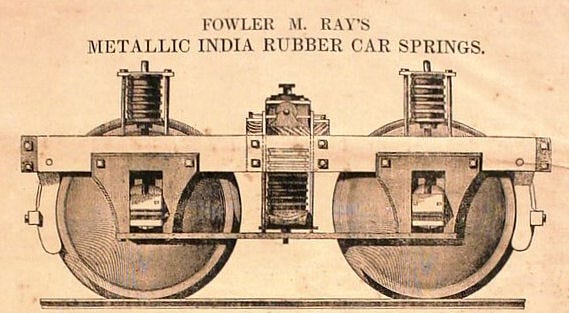
However, Ray eventually filed 33 patents in his short life including patents for India-rubber springs for railway cars. The India-rubber springs made Ray a wealthy man, his company eventually employed 500 workers. From a blacksmith’s assistant, he forged a career based on his ideas. He died a multi-millionaire in 1858 at the age of 49.
In 1834, the 25-year-old Ray believed Lorenzo Fowler, a learned man speaking with scientific authority and official looking charts. Of course, Lorenzo Fowler got lucky—Ray was one of the few Phrenological success stories. Lorenzo Fowler planted a seed of expectation based on a hunch that he misattributed to Ray’s skull lumps.
If Fowler Ray had lived in the 21st century, he would have said that he was not a creative person. So many people claim, like Ray did, that they have no inventive talent and no creativity, which is a self-fulfilling prophecy.
Fowler Ray was the same person before and after phrenology, except that he now believed, with no evidence, that he had a gift for invention. You have that same gift in your field of interest.
You don’t need to have your skull palpated. You don’t need any of the 255 creativity tests floating around. You already have everything you need in your imagination. Start using your imagination more— on big questions, mundane questions, and everything in between.
********
I invite you to see my new play, Black Cat, a high stakes drama of Parkinson’s disease, memory and discoveries of the soul. Black Cat stars accomplished Boston actors Adrianne Krstansky, Christopher Webb and Liz Eng, directed by Steven Bogart.
Performances start next week, Thursday through Sunday, June 18 through June 28 at the Boston Playwrights Theater. Seating is limited so please reserve your tickets early at
https://www.bostonplaywrights.org/visiting-productions